
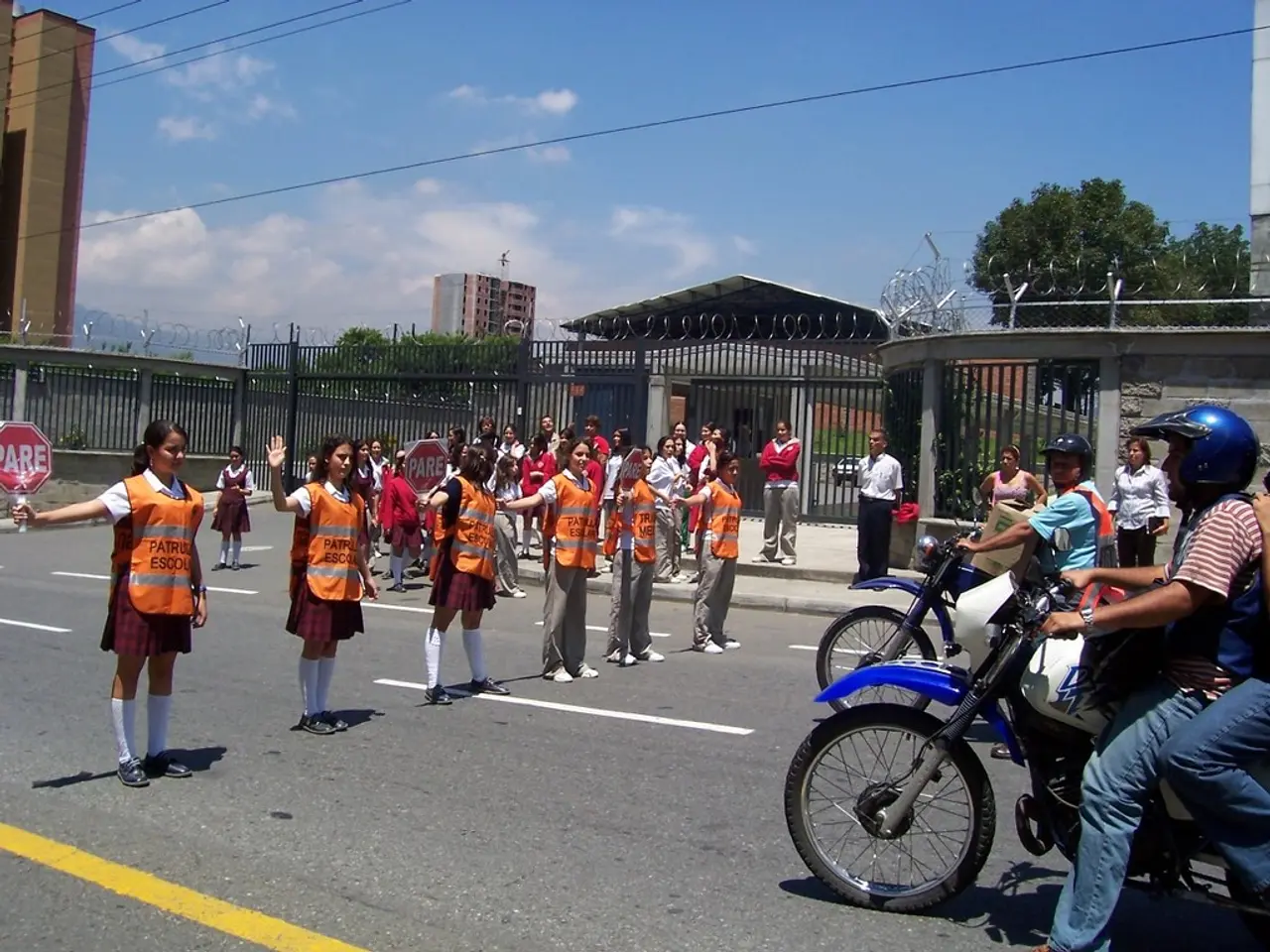
School Councils Tasked with Establishing Pedestrian Zones in Schools
In recent years, the active travel charity Sustrans has been at the forefront of making the school run easier, more enjoyable, and healthier for children in England. Their research indicates that active travel to school, such as walking, cycling, or wheeling, can lead to children spending quality time with their friends and family, being more alert and engaged in class, and even being healthier [1].
One of the initiatives that Sustrans supports is the implementation of School Streets. These are roads outside schools with motorized traffic restrictions at the start and end of the school day. The government's Active Travel Fund has benefited more than 180 school streets in England [6]. Notable supporters of this initiative include Rachel Toms, Director of Urbanism at Sustrans, and National Active Travel Commissioner Chris Boardman [3][7].
Chris Boardman believes School Streets help children build healthy travel habits for life and can reduce congestion on roads during school run times [4]. The scheme aims to reduce traffic volume, congestion, speeding, and pollution around schools, enhancing child and pedestrian safety [2][5].
Successful schemes often emerge from requests or consultations with schools, parents, residents, and local authorities. Ongoing communication helps address concerns such as traffic displacement to nearby streets and ensures public support [2]. Implementing schemes as trials or phased projects, with monitoring of traffic volumes, parking behavior, illegal driving, and safety outcomes, allows adjustments to be made before permanent adoption [1][2][3].
Traffic exclusion at key times, stakeholder engagement, safety improvements, and monitoring impacts are key considerations when planning and implementing a School Street scheme [8]. Clear definition of times of operation, signage, enforcement methods, and permit eligibility are necessary to ensure compliance and smooth function of the scheme [1][4].
Rachel Toms looks forward to working with councils to make it easier for children to walk, wheel, and cycle to school. School Street designs can vary, from covering a whole street to several streets around the school, with the aim of maximizing effectiveness and minimizing undesirable impacts [1].
Local authorities often provide detailed guidance and best practice resources to facilitate planning and implementation [2]. By limiting vehicle access, the scheme encourages walking, cycling, and wheeling for pupils and parents, promoting healthier lifestyles and safer school environments [1][3][5]. Reductions in vehicle use around schools contribute to lower air pollution levels, supporting public health goals [5].
Taken together, these considerations guide the design and operation of effective School Street schemes aimed at creating safer, healthier, and more pleasant school environments in England. For more information, you can access the relevant guidance document [2].
- The Sustrans-supported School Streets, aimed at fostering healthier lifestyles, encourage children and parents in the neighboring community to walk, cycle, or wheel to school, thus enhancing the home-and-garden lifestyle by promoting less polluted and safer environments.
- By engaging stakeholders, such as schools, parents, residents, and local authorities, in the planning and implementation process of School Streets, the community can work together to address concerns, ensure public support, and ultimately create education-and-self-development opportunities through the adoption of healthier travel habits for life.